Discovery and Exploration
In 1984, 120 years after the Alabama sank, the French Navy mine hunter Circé, picked up the sonar image of a wreck whose general characteristics corresponded with those of the Alabama. Over an eight-year period, the French Navy had been hunting for the Alabama as a training exercise for sonar operators. The search had been fruitless. The sea floor off Cherbourg is littered with wrecks of all shapes and sizes, many from World War II.
News of the discovery was kept more or less secret, and the French Navy exercised surveillance of the site to prevent pilfering. The wreck lies within the limited access zone of the important French submarine base at Cherbourg, six miles off the coast on a bed of sand and gravel at a depth of 185 feet.
Divers sent down to verify the identity of the wreck returned to the surface with a plate and confirmed the presence of a wooden hull. Analysis of their observations during subsequent dives and of the few unattached objects lying outside the hull and brought up from the depths indicated the wreck was almost certainly the Alabama. It lay almost perpendicular to the Channel current and upright on the sea floor with a slight 30-degree list to starboard. The port side was largely eaten away by the currents and abrasive sand which is progressively destroying the ship's structure. The starboard side was mostly intact, preserved by a wall of sand built up by the strong currents.
Scientific investigation of the wreck began in earnest in 1988 under the supervision of French Navy captain and underwater archeologist Max Guérout, who obtained the original construction plans from the Laird shipyard and positively identified the wreck as that of the Alabama. Captain Guérout subsequently retired from the Navy in order to devote full time to the Alabama project under the authorization of the French Ministry of Culture.
In May and June of 1988, during relatively calm water periods, 162 Scuba dives were made to the wreck. Dives have continued each following year during the same period, when the days are longer and the visibility is better. Due to the great depth and the hostile natural environment, free dives are limited to a maximum of 15 minutes. The water is dark and turbid, and the extreme force of the current makes all exploration impossible except at slack water and neap tides. To overcome these impediments, a small submarine Intersub with powerful lights has been employed. The Alabama's boilers are visible. Part of the telescoping funnel remains erect, and the imposing mass of her retractable propeller with its unique hoist system rises 15 feet above the ocean floor.
Artifacts retrieved include items from the ship's ceramic dinner service; toilet bowls with blue Romantic Italian landscapes covering their entire porcelain interiors, plus part of an intricate brass flushing mechanism; and part of the galley chimney. The pièce de resistance, however, and the object which conclusively identified the wreck as being the Alabama, is the great bronze wheel bearing the Alabama's motto in French: "Aide-toi et Dieu t'aidera" (God Helps Those Who Help Themselves).
The artifacts have been treated and preserved by experts from the French public utility Electricité de France (EDF), who were among the first to develop electrochemical technology with which they also treated artifacts recovered from the Titanic.
By mutual agreement and in close cooperation with the French Navy, exploration of the wreck is under the strict supervision of a joint French-American Scientific Committee. After a lengthy series of bilateral negotiations over ownership of the artifacts salvaged from the wreck, which lies within today's French territorial waters, the French government in 1991 officially recognized U.S. ownership of artifacts from the Alabama and permitted their export for exhibition in the United States.
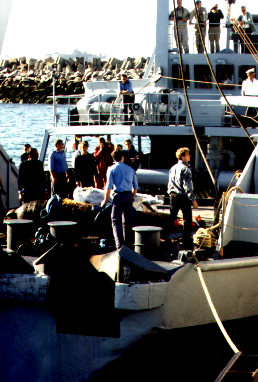
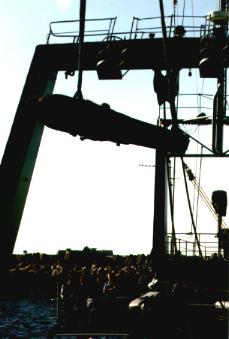
In June 1994, Captain Guérout and his team succeeded in the most ambitious Alabama salvage operation yet--bringing up a unique 3.2-ton rifled artillery piece known as the Blakely pivot gun, still loaded with a dangerous explosive shell containing dry powder. In March 1995, the shell was defused by French explosives experts on the grounds of the EDF laboratories of Archéolyse International in Cannes, where the cannon received conservation treatment.
Can the legendary ship herself be raised? Not yet with today's technology, say the experts. She lies too far down, and the currents in the Channel are too strong. However, she has delivered surprises and made her mark in history more than once before. The Alabama has joined the Titanic and the Bismarck in that small but select group of ships people cannot forget. The saga of CSS Alabama will continue.
© C. Henze 1999
| previous | start | next |