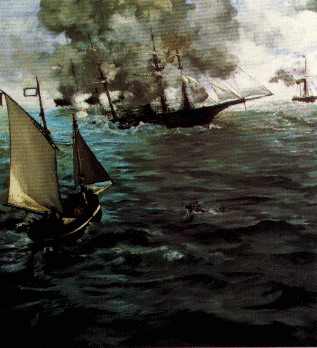
At first Alabama's firing was rapid and wild. Her aiming was poor because practice had been neglected to save ammunition. Observers also noticed that Alabama's powder smoke was dark, indicating deterioration, while smoke from the Kearsarge's powder was white. Semmes told his men to fire low to take advantage of the ricochet effect. The Kearsarge was struck 28 times, but Winslow had hung anchor chain over both sides of his wooden midship section as armor, and she suffered only minor damage, mainly to her sails and rigging.
The two ships were not as equal as Semmes had believed. Kearsarge's firing was much more accurate and deadly. The unprotected hull of the Alabama was holed in several places. Semmes' right arm was totally disabled by a shell fragment. The carnage aboard the Alabama was terrible. Some of the crew were literally torn to pieces by an 11-inch shell. Others were mutilated by splinters. The crew of one pivot gun was replaced four times during the action since nearly every man serving it was disabled. Sailors shoveled grisly masses of flesh overboard and quickly resanded the gory decks.
A shell had exploded in Alabama's side between decks, opening gaping holes. Using full steam, Semmes tried to reach the French coast, but the crippled Alabama was rapidly filling with water, which extinguished the fires in her furnaces. Semmes hauled down his colors to prevent further useless slaughter of his men. Kearsarge ended the mortally wounded Alabama's death struggle by delivering a coup de grâce with a last round of cannon fire. Captain Winslow's triumphant log entry reads, "We fought her until she would no longer swim--then we gave her to the waves."
It was shortly past noon, and the battle had lasted just over an hour when Semmes gave the order "All Hands Save Yourselves!" A sailor helped the injured Semmes take off his coat. Another pulled off his boots. Captain Semmes then flung his sword into the water before plunging overboard himself.
Like a living creature in agony, Alabama threw her bow high out of the water and then slid rapidly beneath the surface, stern foremost and almost vertical, creating a large whirlpool and leaving a floating line of wreckage mingled with the bobbing heads of sailors struggling to be saved.
The battle was commemorated in a painting by no less an artist than Edouard Manet, now in the John G. Johnson collection in the Philadelphia Museum of Art.
Captain Semmes had the satisfaction of saving all his wounded men, who were passed carefully into a boat and sent off to the Kearsarge. Of the 70 prisoners taken by the Kearsarge, three were dying and 17 were wounded.
A private British yacht picked up 42 men from the Alabama, including Semmes and 14 other officers, and carried them to England. Alabama's casualties numbered 43, 26 of them killed or drowned. One of the drowning victims was a young former slave named David White, whom Semmes had freed when he captured the Tonawanda in October 1862. White had voluntarily signed on as wardroom steward aboard the Alabama and had not told anyone he could not swim. Kearsarge had only one man killed and two wounded of her crew of 163.
© C. Henze 1999
| previous | start | next |